Applicable Operating Conditions
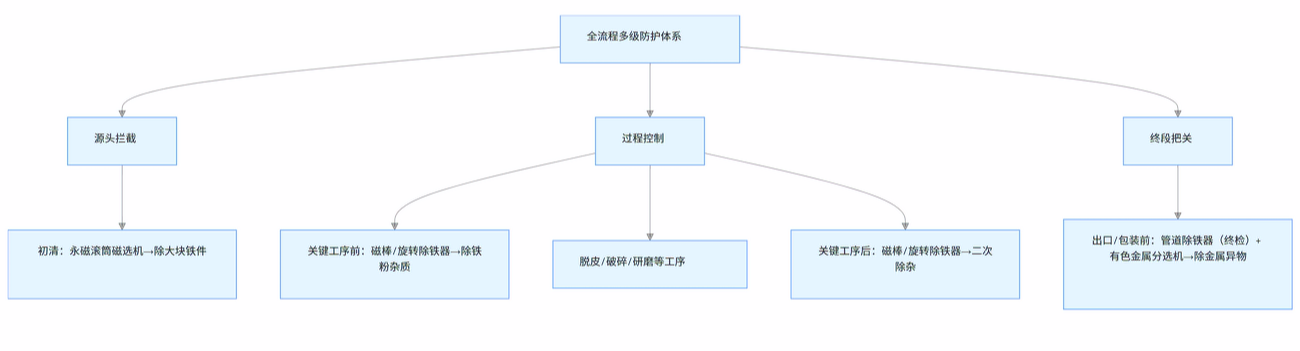
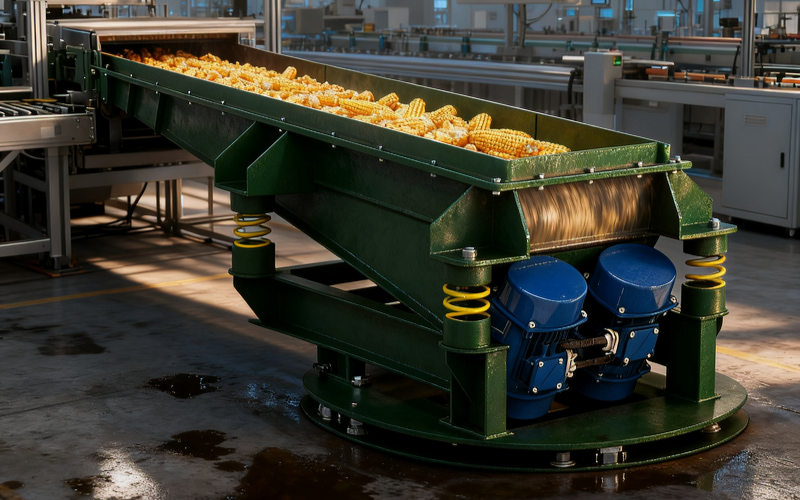
Grain, beans, corn, sugar, salt, and feed pellets are typically conveyed continuously through discharge hoppers, elevators, silos, metering and batching equipment, processing machinery, and packaging systems. Magnetic contaminants may originate from raw materials, transport vehicles, wear on storage bins and conveying equipment, maintenance operations, or parts from upstream equipment. Ferrous contaminant removal points should be strategically arranged to “intercept early, protect critical equipment, and perform final verification,” rather than simply adding one device at the finished-product stage.
Typical Installation Locations
- Discharge and Incoming Material Inlets:These locations are ideal for capturing iron wires, screws, small tools, and magnetic fragments that enter with the raw materials, reducing their likelihood of advancing into elevators and processing equipment.
- Silo Outlets:Material flow is usually concentrated here, making it suitable for installing magnetic grates, drawer magnets, or bullet magnets; simultaneous consideration of hopper angles, instantaneous flow rates, and maintenance access is required.
- Before Grinding, Pelleting, and Mixing Equipment:The primary objective is to protect critical machinery, with particular attention to larger or sharp metallic contaminants.
- Before Packaging and Finished-Product Silos:This location is used to control magnetic swarf generated during processing, complementing screening or metal detection.
Selecting the Appropriate Equipment Configuration
Magnetic Grates and Drawer Magnets
These are suitable for gravity-fed free-fall applications where materials can pass smoothly through the magnetic rod array. Staggered multi-layer arrangements increase contact opportunities, but excessively narrow spacing may impede the passage of large or irregular particles. For hygroscopic materials such as sugar and salt, it is essential to specify ambient humidity levels, caking tendencies, and cleaning requirements.
Bullet Magnets
Their internal magnetic core and flow-guidance design allow materials to remain close to the magnetic field within a relatively unobstructed path, making them well-suited for high-flow applications or situations where minimal channel restriction is desired. Interface types, installation orientation, and clearance space for maintenance doors should be determined in conjunction with existing piping layouts.
Automatic Cleaning Solutions
When the amount of captured debris is substantial, cleaning frequency is high, or production cycles do not permit manual shutdowns, automated drawer mechanisms or other automatic iron-removal methods can be considered. Whether cleaning can be performed without interrupting material flow depends on isolating valves, the number of magnetic rod layers, the iron-collection chamber, and the sequence of control operations.
Food Safety and Hygiene Requirements
The materials, surface treatments, welding, sealing, disassembly, and compatibility with cleaning agents in food-contact areas must be confirmed item by item. The food-related operating conditions described on this page do not imply that the equipment automatically meets any specific certification or all hygiene standards; if customers have internal standards, acceptance documents, or cleaning procedures, these should be provided prior to design.
Commonly Overlooked Issues
- Only average flow rates are provided, without specifying peak surges when gates are opened.
- The particle stream contains powders, long fibrous strands, and large agglomerates, resulting in flow characteristics that differ from those of a uniform particle size.
- Magnetic contaminants may be embedded within agglomerates, making surface contact alone an insufficient basis for evaluating performance.
- Cleaning access points are positioned too high, too narrow, or adjacent to other equipment, complicating subsequent maintenance.
- Magnetic separation is treated as the sole control measure, neglecting screening, equipment maintenance, and end-of-line detection.
Recommended Data to Provide
Please supply the material name and photographs, particle-size range, maximum lump size, bulk density, hourly and instantaneous flow rates, moisture content, interface dimensions, cleaning frequency, and samples of the metals you wish to remove. If the material has food-contact or cleaning requirements, please also provide relevant materials and hygiene standards. Equipment performance should be evaluated under clearly defined conditions; sample-validation testing can be further discussed as needed.
Structural and Principle Diagrams
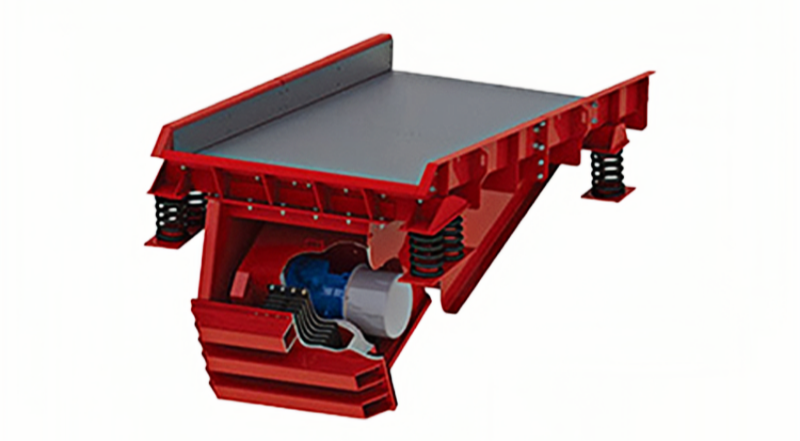
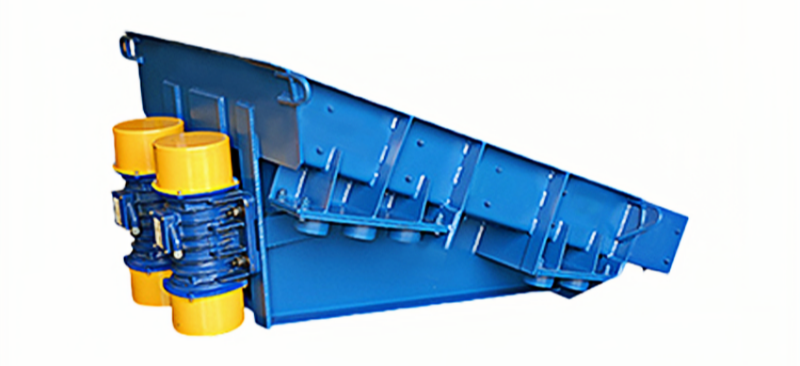
The following are the company’s existing equipment, internal structures, and working-principle documentation, intended to aid in understanding the available configurations, combinations, and installation options. The final configuration will still need to be confirmed based on the material properties, flow rates, installation space, and cleaning requirements.