What problem does this step solve?
Many instances of unstable sorting are not due to insufficient capacity of the downstream equipment, but rather to continuous fluctuations in the feed: large pieces and fines are mixed together, material arrives in heaps, target metals become buried, wet materials stick to the belt, or residual ferrous components enter subsequent equipment that is unsuitable for handling ferromagnetic metals. A resource recovery line should first establish controlled particle size, flow rate, and material layer before addressing fine sorting.
The role of particle size control
Screening or classification can separate materials with widely differing motion characteristics. Similar particle sizes make it easier to select the feed rate, drum or rotor settings, and position the deflectors. Finer classification is not always better: screen aperture, screen blinding, dust generation, moisture content, material loss, and throughput must all be considered together.
- Oversized items can be processed separately before entering the main unit, reducing blockages and impact.
- The main particle size fraction enters the continuous magnetic separation or non-ferrous sorting stream.
- Fine powders and lightweight materials may require separate collection, dust extraction, or dedicated equipment, rather than sharing parameters with larger particles.
Stable feeding and thin-layer distribution
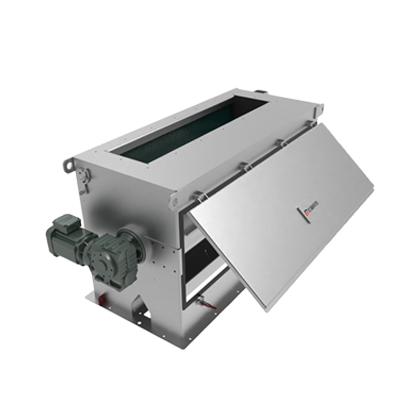
Vibratory feeders, conveyors, and guide structures can be used to control instantaneous flow rates, ensuring that the material covers the effective working width. Equipment selection must take into account material bulk density, particle size, moisture content, target flow rate, and feed width. The trough material, liners, amplitude, and installation method also need to consider wear, noise, and the site foundation.
“Uniformity” refers not only to an average flow rate close to the set value, but also to lateral distribution, longitudinal continuity, and material layer thickness. If the material concentrates on one side or enters in clumps, the effective width of the downstream equipment cannot be fully utilized.
Three approaches to pre‑separation of ferromagnetic materials
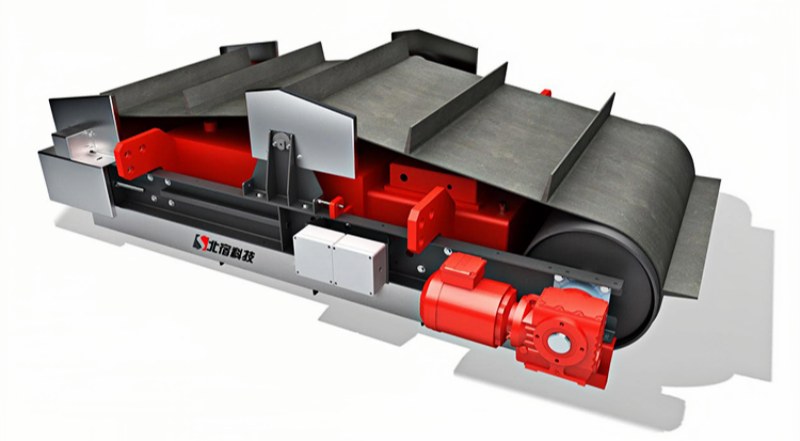
Suspended magnetic separator
Suitable for removing larger ferromagnetic objects above the conveyor belt or at discharge transfer points. Permanent magnet or electromagnetic configurations should be determined based on the material layer, installation height, cleaning frequency, and iron‑removal space. When metal content is high, automatic iron removal and collection channels should be considered.
Magnetic head pulley
Can serve as the head pulley of a conveyor, causing magnetic and non‑magnetic materials to follow different trajectories. Both new line designs and retrofit projects must assess the belt structure, wrap angle, discharge clearance, and deflector positioning.
Drum magnetic separator
Ideal for continuous processing of granular or crushed material after feeding. For conditions involving fine iron contaminants, varying particle sizes, and fluctuating magnetic material content, the drum’s magnetic circuit, rotational speed, and multi‑stage processing can be discussed, but should be based on validation with representative materials.
Why protect downstream eddy current separators
Before entering the high‑speed rotor and conveyor belt area, the risk of residual ferromagnetic metals and oversized items should be minimized as much as possible. Ferromagnetic objects may be attracted by strong magnetic fields, get stuck, or overheat, and they can also damage belts and equipment. Even after pre‑separation, inspection, cleaning, and emergency shutdown procedures should still be established; upstream magnetic separation should not be regarded as an absolute guarantee.
On‑site confirmation checklist
- The proportion of each particle size fraction after crushing and screening, along with the maximum size.
- Hourly average flow rate and short‑term peaks, including whether there are instances of dumping entire batches at once.
- Material moisture, adhesion, entanglement, and dust levels.
- Ferromagnetic metal content, maximum size, shape, and source.
- Feed width, belt parameters, elevation differences between upstream and downstream equipment, and collection space.
Only after confirming these conditions can further discussions proceed regarding the combination and sequencing of feeders, suspended magnetic separators, magnetic head pulleys, and drum magnetic separators.
Structures and schematic diagrams
The following are the company’s existing equipment, internal structures, and operating principle documentation, intended to aid in understanding the available configurations, combinations, and installation methods. The final configuration must still be confirmed in light of the material, flow rate, installation space, and cleaning requirements.