Feeders and Conveyors
Light-Duty Electromagnetic Vibratory Feeder
OVERVIEW
Product Overview
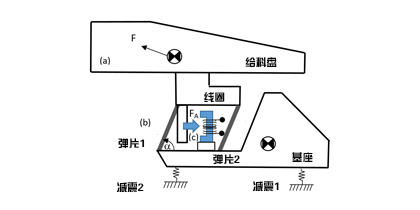
The electromagnetic vibratory feeder is an elastic system based on the principle of directional forced vibration of a two-mass system. Its core power source is an electromagnetic exciter; when the equipment is energized, a unidirectional pulsating current—rectified by half-wave rectification—flows through the coil, generating high-frequency pulsed electromagnetic attraction between the iron core and the armature. During the positive half-cycle of the AC, the electromagnetic force attracts the armature, driving the trough backward while the main spring deforms and stores potential energy. In the negative half-cycle, the electromagnetic force vanishes, and the spring releases its stored energy, pushing the trough forward. This cyclical motion causes the trough to perform reciprocating linear vibrations at a frequency of 3,000 cycles per minute. Owing to the typical 10°–15° inclination angle of the trough, the material is continuously propelled forward in a parabolic trajectory under the combined action of inertial and gravitational forces, thereby achieving uniform and stable feeding and conveying.
Features and Advantages
- Precise Quantitative Feeding: Supports stepless speed regulation, allowing adjustment of the feed rate to meet automated batching requirements.
- Simple and Durable Structure: Lacks complex transmission components, ensuring stable operation, low failure rate, and easy maintenance.
- Energy-Efficient and Low-Noise Operation: Utilizes the electromagnetic vibration principle, resulting in low energy consumption and minimal noise, making it well suited for continuous production environments.
- Low Wear and Long Service Life: The material moves in a gentle parabolic trajectory, reducing friction within the trough and extending the equipment’s service life.
- Flexible Installation: Supports either suspended or base-mounted installation, allowing for adaptable layout according to site conditions.
Optional Configurations
- Structural Forms Available: Open type, fully enclosed type, light trough type, flat trough type, and wide trough type.
- Installation Methods Available: Suspended mounting (hung beneath the hopper) or base mounting (directly installed on a foundation).
- Trough Material Options: Ordinary carbon steel, wear-resistant alloy steel, and food-grade stainless steels 304/316L (suitable for the food and pharmaceutical industries).
- Control System Options: Manual control box or fully automatic PLC remote control (compatible with 0–5 V or 4–20 mA signal interfaces), enabling integration with the entire production line.
Applications
- Mining and Metallurgy: Installed at the discharge outlet of hoppers and at the front end of conveyor systems to provide uniform feeding prior to crushing and screening.
- Coal and Building Materials: Mounted on coal-handling systems and raw-material conveyors to ensure continuous, uniform feeding during batching and transportation processes.
- Food and Pharmaceuticals: Positioned at feeding inlets and along conveying lines to deliver hygienic, precisely metered quantities before grinding, sieving, and packaging.
- Chemical and Light Industries: Installed at hopper outlets and within conveying systems to enable automated, quantitative feeding during batching and mixing operations.
Handled Materials
- Granular and Small-Bulk Materials: Coal, ores, aggregates, plastic pellets, fertilizer granules, etc.
- Powdered Materials: Flour, starch, coal dust, cement powder, chemical powders, etc.
SPECIFICATIONS
Specifications
| Model Model | Power Power | Amplitude Amplitude | Weight Weight | Capacity Handling capacity | Feeding Weight Feed weight | Amplitude Amplitude |
| (W) | (Amp) * | (Kg) | (T/h) • | (Kg) | (mm) | |
| FT-0 | 15 | 0,18 | 4,3 | 0,6 | 1,5 | 1,5 |
| FT-01 | 20 | 0,4 | 10 | 2 | 2,7 | 1,5 |
| FT-02 | 35 | 0,55 | 15 | 8 | 4,2 | 2,3 |
| BF-01 | 50 | 1,2 | 14 | 5 | 6 | 1,5 |
| BF-2 | 80 | 2 | 30 | 9 | 9 | 1,5 |
DOWNLOADS
Downloads
DISCUSS YOUR APPLICATION
Unsure whether this product fits your material?
Share your material, capacity, temperature and contaminant details, and we will help you evaluate the next step.