Feeders and Conveyors
Heavy-Duty Electromagnetic Vibratory Feeder
OVERVIEW
Product Overview
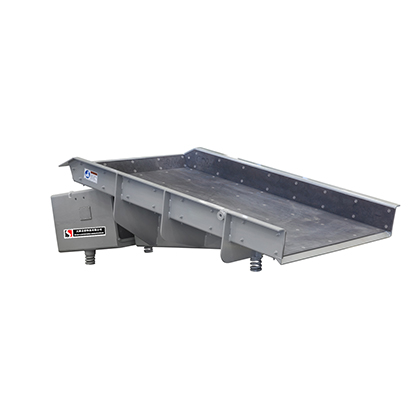
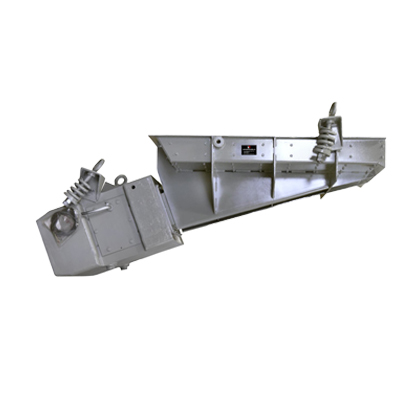
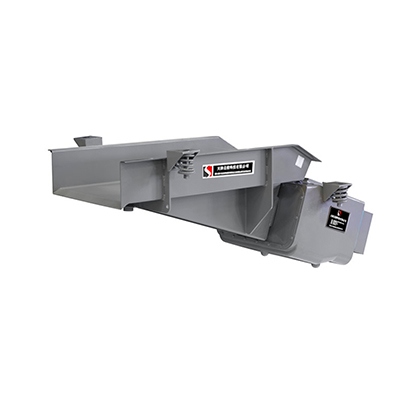
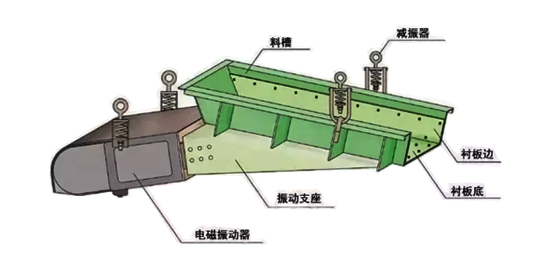
The equipment consists of a working mass (trough), a driving mass (vibrator), and a counterweight mass (or base), all connected via primary vibration springs. When the electromagnetic vibrator is energized, it generates periodic electromagnetic attraction forces, which drive the driving mass and the working mass (trough) to produce directional high-frequency reciprocating vibrations supported by the spring system. This vibration causes the material in the trough to be continuously and uniformly thrown forward and allowed to slide. By adjusting the magnitude of the excitation current, the amplitude and feed rate can be precisely controlled, enabling the smooth conveyance of large-sized, high-density materials while effectively preventing direct impact on downstream equipment.
Features and Advantages
- High Load Capacity and Large Production Rate: Featuring a heavy-duty trough structure with strong impact resistance, it is suitable for high bin pressure and continuous feeding at high throughput.
- Strong Environmental Adaptability: Equipped with dust-proof and moisture-proof capabilities, it can operate stably under high-temperature and harsh conditions.
- Smooth Operation and Low Noise: Utilizing a two-mass vibration mechanism, it ensures stable running, low noise, and minimal vibration impact on the foundation.
- Long Service Life: Core components are wear-resistant and fatigue‑proof, resulting in low failure rates and enhanced durability over extended operation.
- Precise and Stable Feeding: Supports rapid start‑stop operations and feed rate adjustment, meeting the demands of automated continuous production.
Optional Configurations
- Trough Design Options: Open type, fully enclosed type, and pre‑screening bar type.
- Installation Methods: Suspended mounting (hung beneath the hopper) or base-mounted installation (directly installed on a robust concrete foundation).
- Trough Material Options: Ordinary carbon steel, wear‑resistant alloy steels (such as manganese steel for highly abrasive ores), and high‑temperature resistant special steels.
- Control System Options: Local manual control cabinet, fully automatic PLC remote control, and intelligent integration with the entire crushing and screening production line.
Applications
- Mining and Metallurgy: Installed at the discharge outlet of hoppers and at the front end of conveyor systems, providing uniform feeding prior to crushing and screening.
- Coal and Building Materials: Mounted on coal handling systems and raw material conveying lines, delivering continuous, uniform feed during batching and transportation processes.
- Food and Pharmaceutical Industries: Positioned at feeding inlets and conveying pipelines, ensuring hygienic, quantitative feeding before grinding, sieving, and packaging.
- Chemical and Light Industries: Installed at hopper outlets and within conveying systems, enabling automated, quantitative feeding during batching and mixing operations.
Handled Materials
- Large‑size Ores and Rocks: Iron ore, copper ore, granite, basalt, limestone, river pebbles, etc.
- High‑Temperature and Highly Abrasive Materials: Sintered ore, coke, high‑temperature clinker, wear‑resistant aggregates, etc.
- Bulk Bulk Solids: Raw coal, sand and gravel, glass raw materials, fertilizer raw materials, and similar materials.
SPECIFICATIONS
Specifications
| Model Model | Standard Feed Tray Standard tray | Capacity Handling capacity | Weight Weight | Power Power | Input Current Input current | |
| (mm) | (inch) | (TPH) | (Kg) | (W) | (Amp)* | |
| F-22 | 355 X 915 | 14 X 36 | 70 | 190 | 250 | 2,5 |
| FH-22 | 457 X 1070 | 18 X 42 | 120 | 210 | 250 | 5 |
| F-220 | 457 X 760 | 18 X 30 | 100 | 195 | 450 | 6 |
| F-280 | 510 X 915 | 20 X 36 | 135 | 215 | 550 | 7 |
| F-330 | 610 X 1220 | 24 X 48 | 235 | 450 | 950 | 15 |
| F-380 | 760 X 1220 | 30 X 48 | 300 | 560 | 125 | 20 |
DOWNLOADS
Downloads
DISCUSS YOUR APPLICATION
Unsure whether this product fits your material?
Share your material, capacity, temperature and contaminant details, and we will help you evaluate the next step.