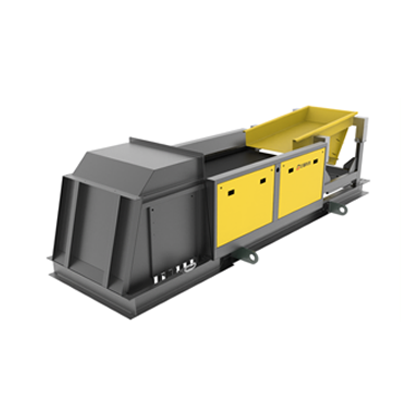
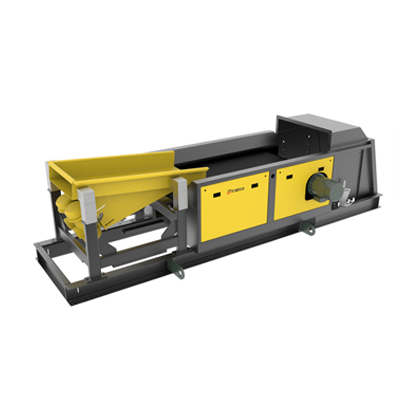
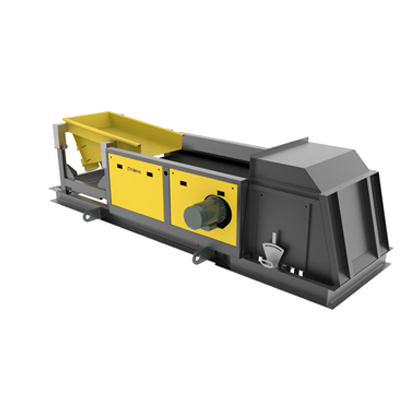
Non-Ferrous Metal Separators
Eddy Current Separator
OVERVIEW
Product Overview
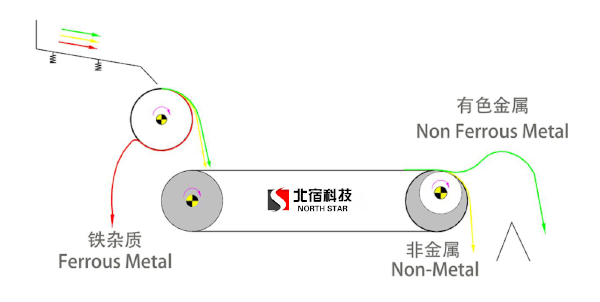
The eddy current separator operates based on “electromagnetic induction” and the “eddy current repulsion effect.” When a mixed material containing non-ferrous metals passes over a high-intensity magnetic drum rotating at high speed, the alternating magnetic poles inside the drum generate a high-frequency alternating magnetic field. As conductive materials (such as copper and aluminum) traverse this field, powerful eddy currents are induced within them. According to Lenz’s law, these eddy currents produce an induced magnetic field that opposes the original field, thereby exerting a strong repulsive force—known as the “ejection force”—on the non-ferrous metal particles. Under the combined action of inertia, gravity, and the repulsive force, the non-ferrous metals are projected forward and deposited into a dedicated collection chute, while non-metallic materials (such as plastics, glass, and rubber), being electrically non-conductive and unaffected by the magnetic field, follow a natural parabolic trajectory and drop separately, thus achieving precise separation of non-ferrous metals from non-metals.
Features and Advantages
- High Sorting Accuracy: Utilizing a high-strength magnetic system design, it efficiently separates copper, aluminum, and even fine non-ferrous metal particles.
- Strong Handling Capacity: The magnetic drum and conveyor belt speeds are adjustable, supporting large-volume, continuous, stable operation.
- Wide Applicability: Suitable for sorting various non-ferrous metals, including copper, aluminum, zinc, lead, and stainless steel.
- Stable and Durable Operation: The robust, wear-resistant equipment design ensures smooth operation, low failure rates, and simplified maintenance.
- Environmentally Friendly and Energy-Efficient: A purely physical separation process with no chemical pollution, wastewater, or exhaust gases, making it more environmentally sustainable and energy-efficient.
Optional Configurations
- Magnetic System Design: Options include standard concentric magnetic systems or highly efficient eccentric magnetic systems (the eccentric type is particularly effective for the precise ejection of larger particles).
- Magnetic Drum Specifications: A range of drum diameters and widths is available, with magnetic field strength customizable to suit specific material characteristics.
- Adjustment Features: Equipped with a frequency converter, the magnetic drum speed, conveyor belt speed, and baffle position can all be continuously adjusted to achieve optimal separation performance.
- Housing Material Options: The material in contact with the feed can be selected as carbon steel with powder coating or all-stainless steel, depending on requirements, to accommodate wet or corrosive environments.
Applications
- Recycling of Waste Household Appliances: Installed on the shredder discharge conveyor line, it separates copper, aluminum, and stainless steel during the crushing and sorting stages, enhancing metal recovery rates.
- End-of-Life Vehicle Disassembly: Deployed on the automotive shredder processing line, it sorts copper and aluminum after crushing and screening, improving metal utilization.
- Recycling of Waste Plastics and Glass: Mounted on plastic flake and glass cullet conveyors, it removes metallic contaminants following crushing and washing, thereby increasing the purity of recycled materials.
- Treatment of Aluminum Ash and Slag: Installed on aluminum ash and slag processing lines, it recovers residual metals after grinding and screening, enabling resource recycling.
- Bottom Ash Treatment from Waste Incineration: Positioned on the incinerator bottom ash conveyor line, it separates non-ferrous metals after crushing and magnetic separation, boosting resource reuse.
Materials Processed
- Electronic Waste: Crushed circuit board fragments, crushed appliance casings, and crushed wire and cable scraps.
- Industrial Waste: Crushed aluminum composite panels, crushed heat sinks, aluminum ash, slag, and metallurgical residues.
- Recycled Resources: Crushed waste plastics, crushed waste glass, crushed used tires, and bottom ash from municipal solid waste incineration.
- Packaging Waste: Crushed beverage cans, mixed metal packaging waste, and similar materials.
SPECIFICATIONS
Specifications
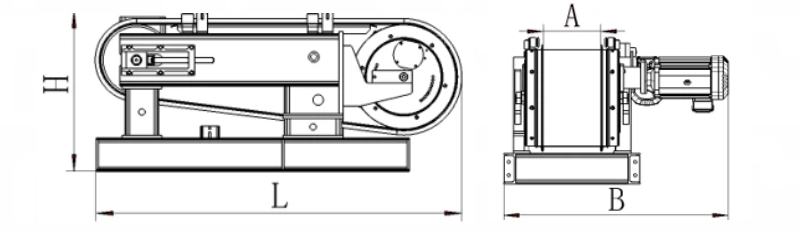
| Non-ferrous particle size Non-ferrous metal particle size (mm) | Model Model | Feeding type Feed type | Magnetic system Magnetic system | Number of Magnetic Poles Number of magnetic poles | Field Strength Magnetic field strength (GS) | Roller speed Magnetic roller speed (r/min) | Rated Frequency Rated frequency (Hz) |
| 60-300 | WFX-12P | - | Eccentric type | 12P | - | 4000 | 733 |
| 10-60 | WFX-22P | - | Eccentric type | 22P | - | 3800 | 733 |
| 5-20 | WFX-22P-H | - | Eccentric type | 22P HI | - | 4000 | 733 |
| 5-20 | WFX-22P-H | Drum separator | Eccentric type | 22P HI | 3000 | 3800 | 733 |
| 0-5 | WFX-38P-H | Feeder-fed | Eccentric type | 38P HI | 3500 | 3000 | 1050 |
| 0-5 | WFX-38P-H | Belt-driven | Eccentric type | 38P HI | 3500 | 3000 | 1050 |
DOWNLOADS
Downloads
DISCUSS YOUR APPLICATION
Unsure whether this product fits your material?
Share your material, capacity, temperature and contaminant details, and we will help you evaluate the next step.